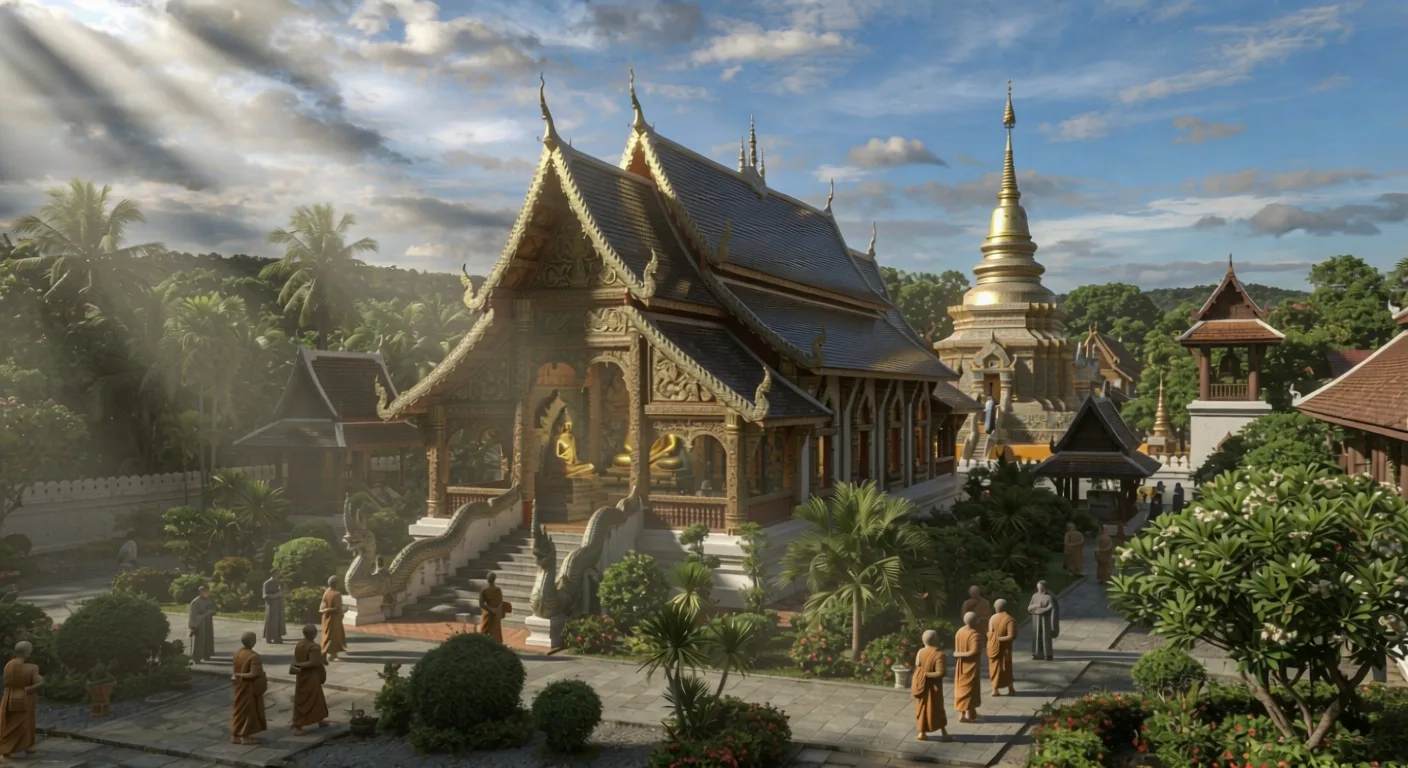
Wat Susahn Sahlahwangthan: The Sacred Legacy of Luang Pho Kasem Khemako
Wat Susahn Sahlahwangthan is a name frequently encountered in Thai amulet collecting literature in connection with Luang Pho Kasem Khemako (หลวงพ่อเกษม เขมโก), one of the most revered meditation masters of Northern Thailand.
The name is commonly rendered in English in several different ways, while Thai sources identify the present-day site primarily as Samnak Sussan Trilak (สำนักสุสานไตรลักษณ์) in Lampang. The location is a meditation and memorial centre associated with Luang Pho Kasem rather than a conventional temple in the usual architectural sense.
Located on the outskirts of Lampang Province, the site became inseparably associated with Luang Pho Kasem's austere meditation practice. He spent much of his life practising meditation and observing a highly simple way of living there, and the location subsequently became one of the most important places of pilgrimage for his devotees.
Today, Sussan Trilak preserves the memory of Luang Pho Kasem through his meditation quarters, memorial buildings, images and sacred objects. His preserved remains are also an important focus of devotion for visitors.
The Meaning of Sussan Trilak
The Thai name สุสานไตรลักษณ์ (Sussan Trilak) can be understood in relation to the Buddhist teaching of the Three Characteristics, or Tilakkhana: impermanence (anicca), unsatisfactoriness or stress (dukkha) and non-self (anatta).
The name is particularly appropriate for a place associated with meditation and contemplation of the nature of existence.
The site's original character was closely connected with cemetery and cremation-ground surroundings. For a forest-oriented meditation practitioner, such an environment could serve as a powerful reminder of impermanence and mortality.
This austere setting became an important part of Luang Pho Kasem's spiritual identity and distinguished his practice from the more institutional environment of an ordinary monastery.
Luang Pho Kasem Khemako
Luang Pho Kasem Khemako was born as Kasem Na Lampang on 28 November B.E. 2455 (1912) in Lampang. Thai biographical sources identify him as coming from the Na Lampang lineage, a family connected with the historical ruling families of the Lanna region.
He became one of the best-known meditation masters of Northern Thailand and was widely respected for his strict discipline, simplicity and commitment to meditation practice.
Rather than seeking worldly recognition, Luang Pho Kasem became famous for his austere lifestyle and dedication to Buddhist practice.
His reputation grew steadily among people who admired his determination to live according to Buddhist principles and his emphasis on meditation and detachment.
Luang Pho Kasem's Early Monastic Life
Traditional biographies record that Luang Pho Kasem entered the monastic life at a young age and subsequently studied Buddhist teachings and Pali.
He spent time studying at several temples in Lampang and developed a strong foundation in Buddhist doctrine.
His education was complemented by practical meditation training, eventually leading him toward the austere Dhutanga tradition.
Dhutanga refers to a group of optional ascetic practices described in the Theravada Buddhist tradition. These practices are intended to encourage simplicity, discipline, restraint and detachment.
Luang Pho Kasem and Forest Meditation
One of the defining features of Luang Pho Kasem's life was his dedication to Vipassana and meditation practice.
He was strongly associated with the Northern Thai forest and cemetery meditation tradition. Rather than regarding comfort and material possessions as important, he emphasised simplicity and concentration.
Traditional accounts describe him as living with very few possessions and spending long periods in secluded locations dedicated to meditation.
This lifestyle earned him widespread respect among devotees who regarded his discipline as an example of serious Buddhist practice.
The Cemetery Meditation Tradition
Cemetery meditation has a long history within Buddhist practice.
Contemplating death and impermanence can help practitioners reduce attachment to the physical body and worldly possessions.
For meditation practitioners, a cemetery is therefore not necessarily viewed simply as a place of sadness. It can become a setting for contemplating the universal realities of ageing, illness, death and impermanence.
Luang Pho Kasem's willingness to practise in such austere surroundings became an important part of his reputation.
The location that eventually became known as Sussan Trilak consequently became closely identified with his meditation life.
Luang Pho Kasem and the Three Characteristics
The concept of Tilakkhana is central to Buddhist insight practice.
Anicca teaches the impermanent nature of conditioned phenomena. Dukkha refers to the unsatisfactory or stressful nature of conditioned existence, while Anatta points to the absence of a permanent, independent self.
The name Sussan Trilak therefore reflects a profound Buddhist meditation theme: observing reality as it actually is rather than becoming attached to permanence, possessions or identity.
Luang Pho Kasem's austere way of life is often remembered in this context.
Luang Pho Kasem's Simple Way of Life
Accounts of Luang Pho Kasem repeatedly emphasise his simplicity.
He is traditionally remembered as a monk who placed little importance on personal possessions. His way of life was centred on his robes, alms bowl, meditation practice and basic necessities.
Stories about his practice describe periods in which he slept simply and remained close to the place where he meditated rather than seeking physical comfort.
This simplicity became an important part of his public image and helped distinguish him as a monk dedicated to spiritual practice rather than material wealth.
Luang Pho Kasem and the Lanna Buddhist Tradition
Luang Pho Kasem occupies an important position in the religious heritage of Lampang and Northern Thailand.
Lanna Buddhism has its own distinctive history, architecture, artistic traditions and monastic lineages.
Luang Pho Kasem's life connected this regional heritage with a strong emphasis on meditation, discipline and personal practice.
His reputation eventually extended well beyond Lampang, making him one of the most widely recognised Northern Thai meditation masters of the twentieth century.
Sussan Trilak as a Place of Practice
The site associated with Luang Pho Kasem developed as a place where his meditation practice could be continued away from the distractions of ordinary urban life.
Thai government tourism information describes the location as being on the outskirts of Lampang along the Lampang–Chae Hom route. A large statue of Luang Pho Kasem is visible from the road, while the complex includes a Thai-style memorial pavilion and a life-size wax figure of the revered monk.
The site also preserves Luang Pho Kasem's former living quarters, allowing visitors to gain an impression of the extremely simple environment in which he practised.
The Memorial Pavilion
A major feature of the site is the mondop-style memorial pavilion dedicated to Luang Pho Kasem.
The building incorporates traditional Thai architectural elements while functioning as a place of remembrance and devotion.
Inside, visitors can pay respects to images of Luang Pho Kasem and learn about his life and practice.
The presence of a life-size wax figure provides devotees with a tangible representation of the monk and has helped establish the location as an important pilgrimage destination.
Luang Pho Kasem's Preserved Remains
One of the most important aspects of Sussan Trilak is the preservation of Luang Pho Kasem's remains.
Following his death, his body was preserved and placed in a glass coffin so that devotees could continue to pay their respects.
Thai government information describes the preserved remains as an important feature of the site and notes that visitors from Lampang and elsewhere in Thailand come to honour him.
For devotees, the preserved remains represent a powerful connection with a monk whose life was dedicated to meditation and Buddhist discipline.
Luang Pho Kasem's Passing
Luang Pho Kasem Khemako passed away on 15 January B.E. 2539 (1996) at a hospital in Lampang.
His death was deeply mourned by his disciples and devotees throughout Thailand.
His passing marked the end of a long life dedicated to Buddhist practice, but his spiritual legacy continued through the meditation tradition associated with his name and the many devotees who continued to visit Sussan Trilak.
The memorial site consequently became an important place for preserving his memory and teachings.
Luang Pho Kasem and Thai Buddhist Amulets
Luang Pho Kasem is also one of the most important names in the modern history of Thai Buddhist amulets.
Amulets and sacred objects associated with his name are highly regarded by collectors, particularly those interested in Northern Thai Buddhist traditions.
Objects associated with Luang Pho Kasem include medallions (Rian), Buddha images, Phra Pidta, votive tablets, cast images, Takrut and other devotional objects.
Different editions were produced during different periods and for different purposes, making the study of Luang Pho Kasem amulets a substantial collecting field in its own right.
Important Luang Pho Kasem Amulet Types
Among the categories encountered by collectors are:
- Rian Luang Pho Kasem – portrait medallions depicting the revered monk.
- Phra Pidta – Buddha images traditionally associated with withdrawal from worldly distractions and auspicious devotional beliefs.
- Phra Buddha images – various Buddha forms issued in different periods.
- Phra Somdej and votive tablets – sacred powder and moulded forms associated with Buddhist devotion.
- Takrut – inscribed sacred scroll amulets made according to traditional practices.
- Cast images and statues – three-dimensional representations of Luang Pho Kasem.
- Special commemorative editions – objects produced to mark important events or support religious and charitable projects.
Collectors should identify each edition separately because the temple or meditation centre name alone does not establish the date, production method or authenticity of an amulet.
Famous Luang Pho Kasem Amulets
Among the better-known collecting categories are the Luang Pho Kasem Rian and various special commemorative issues.
One especially recognised category is the Rian Kong Phan Lampang, or Kong Phan Lampang medallion, which is frequently discussed in Thai amulet collecting literature. Contemporary Thai amulet publications identify it as one of the popular sacred objects associated with Luang Pho Kasem.
Other recognised pieces include early-period Buddha images and medallions associated with the Sussan Trilak lineage.
Some collector references document early Luang Pho Kasem pieces from approximately the late 1960s and early 1970s, illustrating the long history of sacred-object production associated with his name.
Phra Pidta of Luang Pho Kasem
Phra Pidta is another important category associated with Luang Pho Kasem.
The characteristic image depicts the Buddha seated with the hands or arms covering the face. In Thai Buddhist amulet culture, Phra Pidta is often interpreted symbolically as turning away from undesirable influences and worldly distractions.
Various Phra Pidta editions associated with Luang Pho Kasem are known among collectors, including examples containing sacred powder and versions incorporating Takrut.
Collector records document examples from the B.E. 2530s, including Phra Pidta editions produced in B.E. 2536 and B.E. 2537.
Traditional Beliefs Associated with Luang Pho Kasem Amulets
Within Thai devotional culture, Luang Pho Kasem's sacred objects are traditionally associated with qualities such as protection, safety, good fortune, metta, confidence and prosperity.
Some devotees regard his amulets as particularly appropriate for people seeking spiritual reassurance or protection during difficult circumstances.
Business owners and traders may also traditionally associate certain editions with prosperity and successful dealings.
These are matters of religious belief and cultural tradition and should not be presented as scientifically proven supernatural effects.
Luang Pho Kasem's Buddhist Philosophy
At the heart of Luang Pho Kasem's legacy was not the commercial value of amulets but the practice of meditation, discipline and detachment.
His lifestyle demonstrated the importance of reducing attachment to material possessions and concentrating on the development of the mind.
The cemetery environment in which he practised reinforced the Buddhist contemplation of impermanence.
This perspective is essential when studying his amulets. The sacred objects can be appreciated as expressions of devotion and cultural heritage, but they should be understood within the wider Buddhist life and teachings of the monk they represent.
Luang Pho Kasem and Compassion
Despite his austere lifestyle, Luang Pho Kasem was remembered by devotees as a compassionate monk.
Traditional accounts describe people coming to him for advice, blessings and spiritual encouragement.
His reputation for kindness combined with his strict personal discipline created a distinctive image: a monk who lived simply while remaining deeply connected with the people who sought his guidance.
This combination of metta, discipline and meditation became an important part of his enduring popularity.
Wat Susahn Sahlahwangthan in Thai Amulet History
In international Thai amulet collecting circles, the name Wat Susahn Sahlahwangthan is often used when referring to sacred objects connected with Luang Pho Kasem and the Lampang cemetery meditation tradition.
Historical collector listings identify the location as a cemetery or meditation site in Lampang and associate numerous Luang Pho Kasem amulets with it.
For a professional collection database, it is therefore useful to record both the commonly encountered collector spelling and the more accurate Thai designation:
- Collector/English spelling: Wat Susahn Sahlahwangthan
- Thai site: สำนักสุสานไตรลักษณ์
- Common English rendering: Sussan Trilak / Sussan Trilak Meditation Centre
- Province: Lampang
- Associated monk: Luang Pho Kasem Khemako
- Tradition: Northern Thai Buddhist meditation / Vipassana
Collecting Luang Pho Kasem Amulets
Luang Pho Kasem's popularity means that collectors should take particular care when identifying his sacred objects.
A professional identification should consider the following factors:
- Exact edition and year
- Temple or issuing organisation
- Image and mould characteristics
- Material and composition
- Inscription and sacred yantra
- Temple marks or codes
- Original packaging or documentation
- Historical provenance
- Comparison with established reference examples
This is particularly important because Luang Pho Kasem sacred objects were issued over many decades and in numerous forms.
A later commemorative amulet may have significant devotional and cultural value without being an early or rare piece.
Luang Pho Kasem Amulet Materials
Different Luang Pho Kasem issues were made using a variety of materials.
Collectors encounter bronze, brass, silver, sacred powder, clay, mixed powders and other traditional materials.
Some special editions incorporated Takrut or other sacred elements into the amulet design.
For example, collector records document Phra Pidta editions containing gold Takrut and sacred powder from the B.E. 2530s.
The material should therefore be recorded as part of the exact edition rather than assumed from the general name of the monk or site.
Wat Susahn Sahlahwangthan and Northern Thai Heritage
The significance of Sussan Trilak extends beyond Thai amulets.
The site represents a distinctive aspect of Lanna Buddhist heritage, in which meditation, ascetic practice and reverence for respected monks have remained important elements of religious life.
Lampang itself is one of Northern Thailand's historic cultural centres, with a strong tradition of Lanna architecture, Buddhist art and monastic practice.
Luang Pho Kasem's legacy forms an important part of this cultural landscape.
Visiting Sussan Trilak in Lampang
Sussan Trilak is located on the outskirts of Lampang City, along the route toward Chae Hom.
Thai tourism information describes the site as approximately one kilometre from the outskirts of the city and notes the prominent large statue of Luang Pho Kasem that helps visitors identify the location.
The complex includes a memorial pavilion, images of Luang Pho Kasem, his former living quarters and facilities associated with his remembrance.
Visitors should dress respectfully and remember that the site is a place of Buddhist devotion and meditation rather than simply a tourist attraction.
Photography should be conducted with appropriate sensitivity, particularly around sacred images, monks and devotees engaged in religious practice.
Respectful Devotion at Sussan Trilak
Devotees visiting Sussan Trilak commonly come to pay respects to Luang Pho Kasem, make merit and reflect upon his Buddhist life.
The atmosphere of the site encourages visitors to remember the fundamental Buddhist teachings of impermanence and detachment.
Rather than focusing only on the supernatural reputation sometimes associated with sacred objects, visitors can also appreciate the deeper message represented by Luang Pho Kasem's life: simplicity, discipline, meditation and compassion.
Why Wat Susahn Sahlahwangthan Matters
Wat Susahn Sahlahwangthan, understood in the context of Sussan Trilak, is significant because it preserves the spiritual legacy of Luang Pho Kasem Khemako.
For Buddhist practitioners, the site represents a place associated with serious meditation and the contemplation of impermanence.
For the people of Lampang, it is an important part of the province's religious and cultural heritage.
For Thai amulet collectors, it is one of the most recognisable names connected with Luang Pho Kasem's sacred objects.
For students of Thai Buddhism, it provides an opportunity to understand how the forest and cemetery meditation tradition influenced the religious identity of a major Northern Thai master.
Conclusion
Wat Susahn Sahlahwangthan, more accurately associated with the Sussan Trilak meditation and memorial site in Lampang, is one of the most important locations connected with Luang Pho Kasem Khemako.
The site is remembered not primarily for grand architecture but for the austere meditation life of a monk who devoted himself to Buddhist discipline, Vipassana practice and detachment from material possessions.
Luang Pho Kasem's connection with the cemetery meditation environment reflects the Buddhist contemplation of the Three Characteristics: impermanence, unsatisfactoriness and non-self.
His enduring reputation has also made the site highly significant within Thai amulet culture. Rian, Phra Pidta, Buddha images, Takrut and other sacred objects associated with Luang Pho Kasem remain important areas of study and collecting.
For collectors, however, the exact edition, year, material, mould, temple attribution and provenance should always be established before making claims about rarity or authenticity.
For devotees, Sussan Trilak remains a place of remembrance, meditation and spiritual reflection.
Above all, the legacy of Wat Susahn Sahlahwangthan and Sussan Trilak is inseparable from the life of Luang Pho Kasem Khemako—a monk remembered for his simplicity, discipline, meditation practice and profound influence on Northern Thai Buddhist culture.