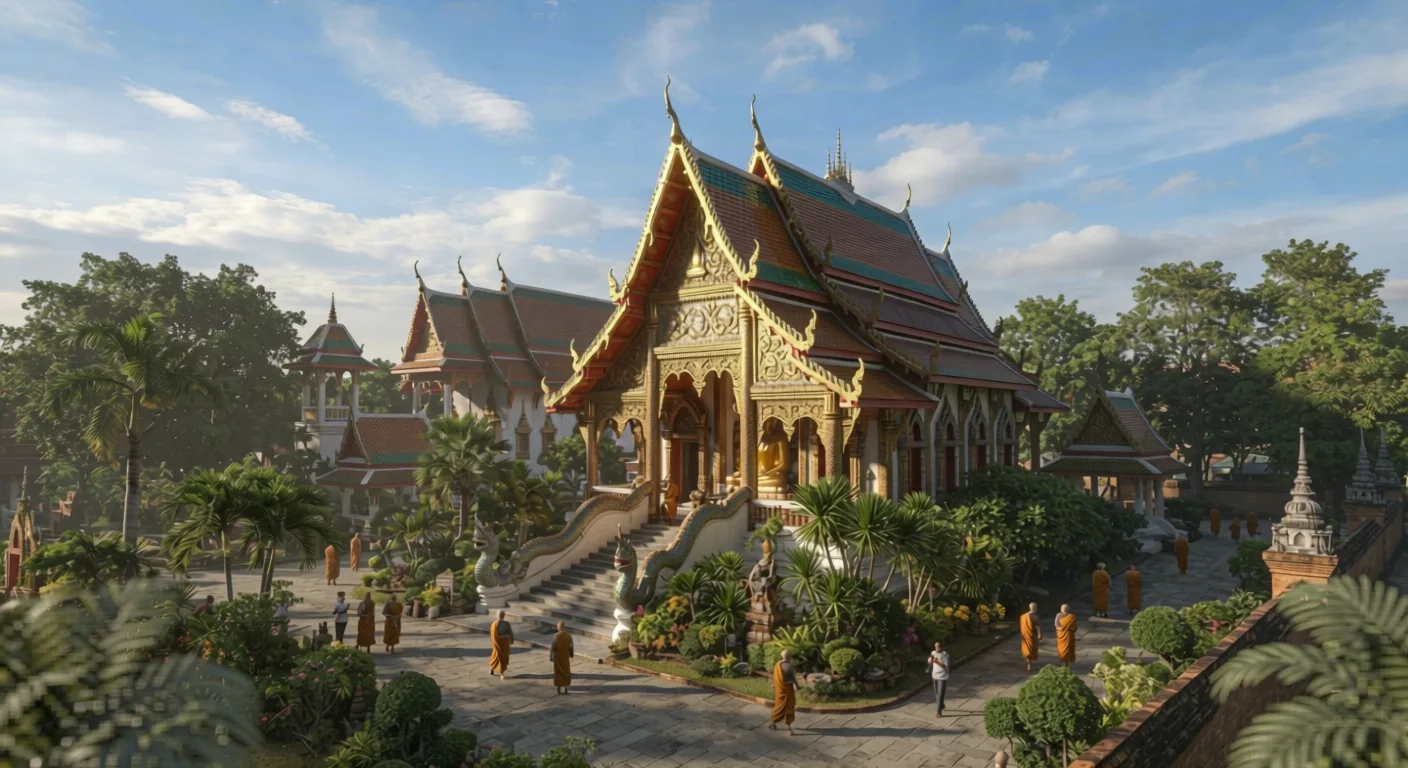
Wat Sam Ngam: A Historic Buddhist Temple in Nakhon Pathom
Wat Sam Ngam (วัดสามง่าม), also known as Wat Aranyikawas (วัดอรัญญิการาม), is a respected Buddhist temple in Don Tum District, Nakhon Pathom Province, central Thailand. The temple is particularly renowned for its association with Luang Pho Tae Kangkhasuwanno, one of the best-known traditional Thai Buddhist masters connected with sacred objects and protective devotional traditions.
For Thai Buddhist devotees and collectors, Wat Sam Ngam occupies a special position because of its connection with Luang Pho Tae and the distinctive sacred-object traditions that developed around his teachings and monastic practice.
The temple is especially famous for Kuman Thong, together with a range of amulets, medallions, Buddha images and traditional talismans attributed to Luang Pho Tae and later generations of the temple.
Beyond its reputation for sacred objects, Wat Sam Ngam is a living Buddhist temple and an important part of the religious and cultural heritage of Nakhon Pathom.
The History and Name of Wat Sam Ngam
Wat Sam Ngam is located in Don Tum District, Nakhon Pathom Province, in an area historically associated with rural Buddhist communities.
The temple is commonly known by the name Wat Sam Ngam, while its formal name is Wat Aranyikawas.
The development of the temple is closely connected with local Buddhist communities and with the efforts of monks who worked to establish and improve the monastery as a centre for religious practice.
One of the most important figures in the temple's history was Luang Pho Tae, whose long association with the temple helped establish its reputation throughout Thailand.
Luang Pho Tae Kangkhasuwanno
Luang Pho Tae Kangkhasuwanno, often referred to as Luang Pho Tae Kong Thong, is the monk most strongly associated with Wat Sam Ngam.
He was born on 15 June B.E. 2434 (1891) in Ban Sam Ngam, Don Tum District, Nakhon Pathom Province. Historical biographical accounts identify his parents as Chan and Bu Sam Ngam Noi.
His early life was closely connected with Buddhist education. According to traditional biographies, when he was approximately seven years old, his uncle, a monk known as Luang Lung Daeng, took him to Wat Kalong in Samut Sakhon Province, where he studied reading, writing, Dhamma and traditional religious knowledge.
This early education became an important foundation for Luang Pho Tae's later life as a monk.
Luang Pho Tae's Ordination
At approximately 15 years of age, Luang Pho Tae entered the monastic life as a novice.
He continued studying Buddhist teachings and traditional practices under the guidance of his uncle and other teachers.
In B.E. 2454 (1911), at the age of approximately 21, he was ordained as a Buddhist monk at Wat Sam Ngam. His preceptor was Luang Pho Tha of Wat Phaniang Taek, a highly respected monk from Nakhon Pathom's Buddhist tradition.
His monastic name was associated with Kangkhasuwanno, although local devotees continued to know him by the familiar name Luang Pho Tae Kong Thong.
Luang Pho Tae and His Teachers
Luang Pho Tae's spiritual and traditional education developed through relationships with several respected teachers.
His early teacher, Luang Lung Daeng, is traditionally described as having taught him Buddhist knowledge as well as traditional forms of sacred knowledge.
His ordination teacher, Luang Pho Tha of Wat Phaniang Taek, was another major influence.
Traditional biographies also associate Luang Pho Tae with the study of meditation and other forms of Buddhist practice under respected masters in Nakhon Pathom and neighbouring provinces.
These teacher-student relationships illustrate the importance of lineage and transmission within traditional Thai Buddhist monastic culture.
Luang Pho Tae's Years of Wandering Practice
One of the most notable parts of Luang Pho Tae's traditional biography concerns his period of travelling and forest practice.
Following his ordination, he is said to have spent many years travelling to different areas, practising meditation and seeking instruction from respected teachers.
Accounts describe a period of approximately 17 years, from B.E. 2455 to B.E. 2472 (1912–1929), during which he travelled and continued his studies.
His travels reportedly brought him into contact with monks and lay teachers from different regions, allowing him to expand his knowledge of Buddhist practice and traditional sacred disciplines.
These years of wandering were an important part of the spiritual identity associated with Luang Pho Tae.
Luang Pho Tae and the Development of Wat Sam Ngam
After returning to Wat Sam Ngam, Luang Pho Tae devoted considerable effort to developing the monastery.
Traditional accounts describe him as a dedicated temple builder who worked under difficult conditions to improve the temple's buildings and facilities.
In earlier times, construction materials were difficult to obtain. Timber sometimes had to be collected from remote forest areas, requiring long journeys and considerable physical effort.
Luang Pho Tae is remembered for personally contributing to these efforts and for dedicating many years to the improvement of the temple.
Luang Pho Tae as a Community Leader
Luang Pho Tae's contribution extended beyond the temple itself.
Traditional biographies describe him as a monk who worked to improve the surrounding community by supporting infrastructure and public services.
Accounts associate him with the development of facilities including schools, roads, water resources and health-related services.
These activities demonstrate an important aspect of traditional Thai monastic life: the temple often served as a centre of education, social welfare and community development in addition to being a place of worship.
Luang Pho Tae as Abbot
In B.E. 2475 (1932), Luang Pho Tae was appointed abbot of Wat Sam Ngam.
The following year, he was also appointed to an ecclesiastical administrative position overseeing several temples in the local area.
His leadership strengthened the importance of Wat Sam Ngam within the local Buddhist community and contributed to his growing reputation as a respected monk.
His long service at the temple is one of the principal reasons why Wat Sam Ngam is now closely identified with his name.
Luang Pho Tae and Traditional Buddhist Practice
Luang Pho Tae's reputation was built around a combination of Buddhist discipline, meditation practice, traditional knowledge and service to the community.
Devotees traditionally respected him for his compassion and his commitment to helping people.
Traditional accounts also describe his interest in protective and auspicious forms of sacred knowledge, which later became strongly associated with the sacred objects produced under his name.
It is important to distinguish these traditional accounts from claims that supernatural abilities have been scientifically established.
Wat Sam Ngam and Thai Buddhist Amulets
Wat Sam Ngam has an important position in the history of Thai Buddhist amulets and sacred objects.
Luang Pho Tae is associated with a wide range of devotional objects, including amulets, medallions, Buddha images, cast images and traditional talismans.
These objects are collected by devotees and Thai amulet enthusiasts because of their historical association with Luang Pho Tae and Wat Sam Ngam.
Traditional collector literature describes examples made from materials including clay, sacred powder, herbs and other traditional substances.
Different issues and types should be studied individually because not every object bearing Luang Pho Tae's name necessarily belongs to the same period or production lineage.
Luang Pho Tae Amulets
Luang Pho Tae amulets are particularly recognised within Thai amulet collecting circles.
Among the types associated with him are portrait medallions, Buddha images, votive tablets, cast images and other devotional objects.
Some historical accounts state that Luang Pho Tae produced sacred objects during periods of national difficulty, including the era surrounding the Second World War.
Collectors traditionally examine these objects according to their mould characteristics, materials, inscriptions, dimensions, surface appearance and historical provenance.
A professional database entry should therefore identify the exact temple, monk, production period, object type, material, edition and provenance wherever such information can be verified.
Kuman Thong of Luang Pho Tae
Wat Sam Ngam is particularly famous for the tradition of Kuman Thong associated with Luang Pho Tae.
Kuman Thong is a distinctive category within Thai folk-religious and Buddhist devotional culture. Traditionally, Kuman Thong refers to a child-like spiritual figure or image associated with protective and auspicious beliefs.
At Wat Sam Ngam, this tradition became strongly associated with Luang Pho Tae and remains one of the major reasons collectors and devotees recognise the temple.
The Kuman Thong tradition surrounding Luang Pho Tae has been transmitted through generations and has become an important part of the temple's popular religious heritage.
The Cultural History of Kuman Thong
The concept of Kuman Thong has a complex history within Thai popular religion and should not be reduced simply to the idea of a “lucky charm.”
Historically, beliefs surrounding child-like spiritual figures developed through the interaction of Buddhist beliefs, local spirit traditions, protective practices and Thai folk culture.
Different periods and temples have interpreted and produced Kuman Thong in different ways.
At Wat Sam Ngam, the tradition became particularly associated with Luang Pho Tae's reputation as a master of sacred objects.
For modern readers, it is useful to understand Kuman Thong primarily as a cultural and religious tradition rather than presenting supernatural claims as established fact.
Traditional Beliefs Associated with Kuman Thong
Within traditional Thai devotional culture, Kuman Thong may be associated with qualities such as protection, good fortune, assistance in business, prosperity and household auspiciousness.
Some devotees traditionally treat Kuman Thong as a spiritual companion and offer food, drink or other symbolic offerings.
Practices differ considerably depending on the tradition, temple and individual beliefs.
These beliefs belong to Thai folk-religious culture and should not be presented as scientifically verified supernatural effects.
Luang Pho Tae's Other Sacred Objects
Although Kuman Thong is perhaps the most famous category associated with Wat Sam Ngam, Luang Pho Tae's sacred-object tradition extends much further.
Historical collector accounts associate him with clay amulets, powder amulets, herbal amulets, portrait medallions, Buddha images, cast images and talismans.
Traditional talismanic objects attributed to him include forms such as Takrut and other protective objects.
These objects reflect the diverse nature of Thai sacred-object culture, where Buddhist devotional practice, protective traditions and local craftsmanship may overlap.
Traditional Materials Used in Luang Pho Tae Sacred Objects
Collector literature describes several traditional materials associated with Luang Pho Tae's amulets.
These may include sacred clay, herbal material, sacred powder and other traditionally prepared substances.
Some accounts also describe the incorporation of materials regarded as ritually significant in traditional Thai practice.
Because production methods and materials can vary between editions, these descriptions should not be automatically applied to every Luang Pho Tae amulet.
For collectors, material analysis should be combined with mould study, historical documentation and provenance when attempting to establish an object's identity.
How to Study Luang Pho Tae Amulets
Collectors interested in Wat Sam Ngam sacred objects should approach authentication carefully.
A professional evaluation should consider:
- Temple: Whether the object is genuinely associated with Wat Sam Ngam.
- Monk: Whether the object can be attributed to Luang Pho Tae or a later abbot.
- Year: The Buddhist Era year or historically documented production period.
- Material: Clay, powder, metal, herbal material or other substance.
- Mould and design: Specific characteristics of the recognised type.
- Inscription: Lettering, symbols or temple marks.
- Dimensions: Measurements compared with established examples.
- Provenance: Documented ownership or acquisition history.
These factors are particularly important because the popularity of Luang Pho Tae has resulted in numerous later commemorative and devotional issues.
Traditional Devotional Beliefs Associated with Luang Pho Tae
Devotees traditionally associate Luang Pho Tae's sacred objects with qualities such as protection, safety, compassion, popularity, prosperity and good fortune.
Some objects are particularly associated with protective beliefs, while others are traditionally connected with attraction, business success or household auspiciousness.
Such claims should be understood within Thai Buddhist and folk-religious devotional culture rather than presented as scientifically proven supernatural effects.
For many devotees, carrying a sacred object also serves as a reminder of Luang Pho Tae's Buddhist example and the values associated with his life.
Luang Pho Tae and Compassion
Traditional biographies portray Luang Pho Tae as a compassionate monk who cared for both people and animals.
Stories about his daily life describe his concern for animals around the temple and his habit of providing them with food.
These accounts contribute to the image of Luang Pho Tae not simply as a master of sacred objects but as a monk whose life was characterised by kindness and concern for living beings.
This aspect of his legacy is particularly important when considering the broader Buddhist context behind the popular devotion surrounding his name.
Wat Sam Ngam and Nakhon Pathom Buddhist Heritage
Nakhon Pathom is one of Thailand's most important provinces for Buddhist heritage.
The region contains numerous historic temples and has been associated with generations of respected Buddhist monks and sacred-object traditions.
Wat Sam Ngam forms part of this wider religious landscape and is especially notable for the legacy of Luang Pho Tae.
The temple's history demonstrates how local monasteries can become nationally recognised through the spiritual reputation of a particular monk and the traditions maintained by successive generations.
Wat Sam Ngam as a Place of Pilgrimage
Devotees visit Wat Sam Ngam to pay respects to Luang Pho Tae, make merit and participate in Buddhist activities.
Collectors and enthusiasts of Thai sacred objects also visit because of the temple's connection with Luang Pho Tae's amulets and Kuman Thong tradition.
For visitors interested in Buddhist history, the temple provides an opportunity to learn about the relationship between monastic life, local community development and Thailand's sacred-object culture.
Respectful Understanding of Kuman Thong
Visitors interested in the Kuman Thong tradition should approach it with cultural and religious sensitivity.
Kuman Thong has different meanings across Thai communities and historical periods. It is therefore inappropriate to assume that all Kuman Thong figures have identical rituals, origins or religious significance.
The Kuman Thong tradition associated with Wat Sam Ngam should be understood within the historical context of Luang Pho Tae, Thai folk religion and the temple's sacred-object heritage.
For collectors, the historical provenance of a Kuman Thong object is particularly important, since many later reproductions and commemorative editions exist.
Visiting Wat Sam Ngam
Wat Sam Ngam is located in Don Tum District, Nakhon Pathom Province, Thailand.
Visitors should remember that the temple remains an active Buddhist monastery and should therefore dress modestly and behave respectfully.
When entering sacred buildings or approaching Buddha images and memorials, visitors should follow local temple customs.
Photography should be undertaken respectfully, especially around monks, worshippers, sacred objects and religious ceremonies.
Visitors interested in Kuman Thong or amulets should also distinguish between objects displayed for historical or devotional purposes and items officially issued by the temple.
Wat Sam Ngam and Thai Buddhist Heritage
Wat Sam Ngam represents an important intersection of Buddhist practice, traditional monastic culture, community development and Thai sacred-object heritage.
Luang Pho Tae's long service at the temple helped establish its reputation throughout Thailand.
His story also illustrates the traditional relationship between a respected monk and the local community. His contribution was not limited to spiritual teachings but extended to the development of schools, roads, water resources and other community facilities according to traditional biographical accounts.
The temple's continuing association with his sacred objects ensures that his name remains an important part of Thailand's religious and cultural memory.
Why Wat Sam Ngam Matters
Wat Sam Ngam is important because it preserves the legacy of one of Nakhon Pathom's best-known traditional Buddhist masters, Luang Pho Tae Kangkhasuwanno.
For Buddhist devotees, the temple represents a place associated with monastic discipline, compassion and Buddhist practice.
For historians, it provides insight into the role of temples and monks in the development of rural communities in central Thailand.
For Thai amulet collectors, Wat Sam Ngam is particularly significant because of the range of sacred objects associated with Luang Pho Tae.
For students of Thai folk religion, the temple's Kuman Thong tradition provides an opportunity to examine the complex relationship between Buddhist devotion, protective traditions and local religious culture.
Conclusion
Wat Sam Ngam, also known as Wat Aranyikawas, is one of Nakhon Pathom's most recognised Buddhist temples and an important destination for anyone interested in Thai Buddhist heritage.
The temple's enduring reputation is inseparable from Luang Pho Tae Kangkhasuwanno, who served as its abbot and devoted much of his life to Buddhist practice, temple development and community service.
Luang Pho Tae's name is particularly famous in the world of Thai sacred objects. His amulets, medallions, Buddha images, talismans and especially the Kuman Thong tradition associated with Wat Sam Ngam remain important subjects for devotees and collectors.
For collectors, however, it is essential to distinguish between historical objects, later commemorative issues and modern devotional products. Accurate identification should be based on temple history, monk attribution, production period, material, mould characteristics and provenance rather than reputation alone.
For devotees, Wat Sam Ngam remains a place where the memory of Luang Pho Tae continues to inspire respect and religious devotion.
Above all, Wat Sam Ngam represents the enduring connection between Thai Buddhism, monastic discipline, community service, sacred-object traditions and the cultural heritage of Nakhon Pathom.