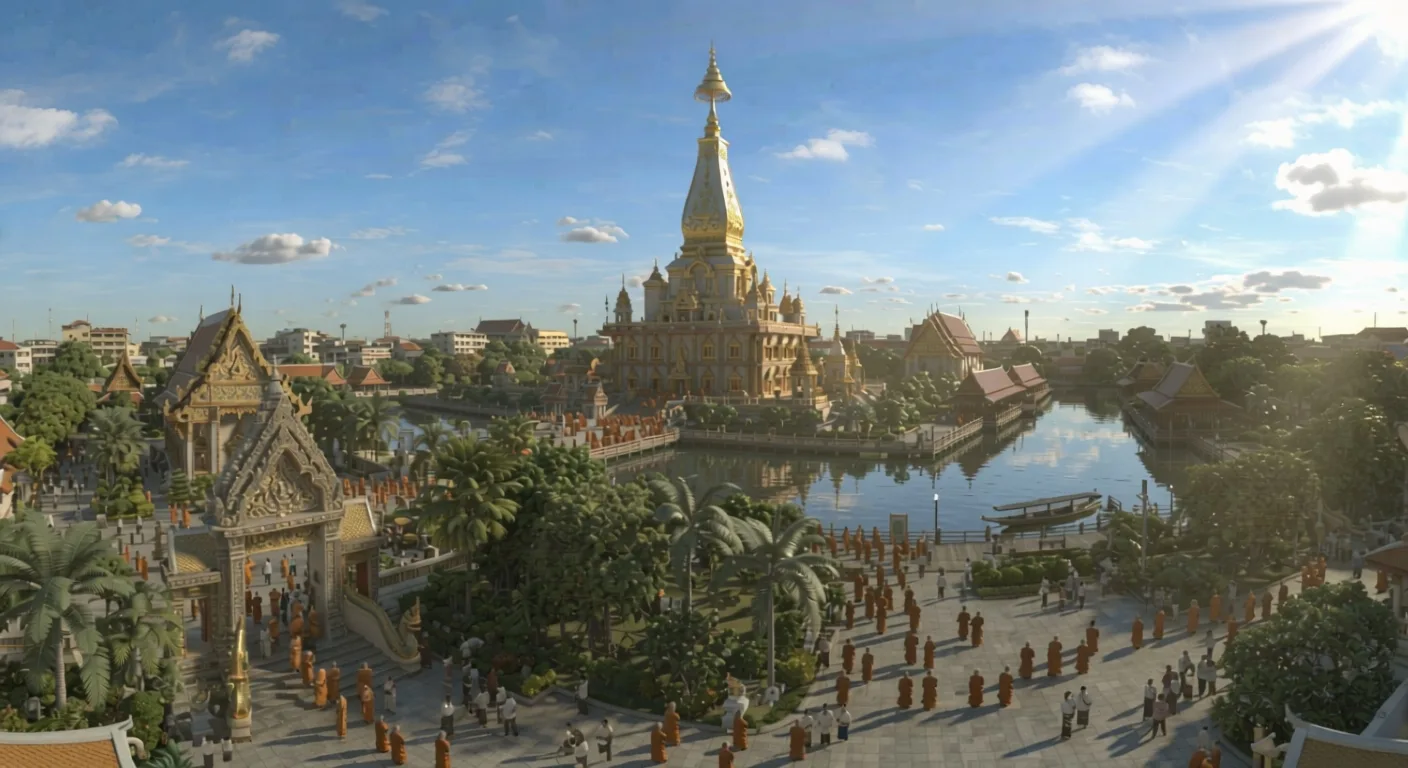
Wat Paknam Bhasicharoen: A Historic Buddhist Temple in Bangkok
Wat Paknam Bhasicharoen (วัดปากน้ำภาษีเจริญ) is one of Bangkok's most significant Buddhist temples and an important centre of meditation, Buddhist education and religious heritage. Located in Phasi Charoen District on the western side of Bangkok, the temple has played an influential role in the development of modern Thai Buddhism.
The temple is particularly famous for its association with Phra Mongkol Thepmuni, commonly known as Luang Pu Sodh Candasaro, one of the most influential meditation masters of twentieth-century Thailand.
Wat Paknam also became an important centre for the meditation method known as Dhammakaya meditation, which is traditionally associated with Luang Pu Sodh and the temple's meditation lineage.
Today, Wat Paknam Bhasicharoen combines historical Buddhist traditions with impressive modern architecture. Its most recognisable landmark is the enormous Phra Maha Chedi Mahachakri Sirindhorn, a multi-storey stupa that has become one of Bangkok's notable Buddhist monuments.
The History of Wat Paknam Bhasicharoen
Wat Paknam is an ancient Buddhist temple located in the area historically known as Pak Khlong Bang Luang, where waterways connect the communities of Thonburi.
The temple's history extends back several centuries, although its exact foundation date is presented differently in various historical accounts. The temple underwent significant development during the Rattanakosin period and gradually became an important religious institution in the Thonburi area.
The name Paknam refers to its location near the mouth or junction of waterways, reflecting the importance of canals and rivers in the historical geography of Bangkok and Thonburi.
As Bangkok developed, Wat Paknam remained an important Buddhist centre and eventually became particularly famous because of the leadership of Luang Pu Sodh Candasaro.
Luang Pu Sodh Candasaro
Phra Mongkol Thepmuni (Sodh Candasaro), widely known as Luang Pu Sodh, was born on 10 October B.E. 2427 (1884) in Amphawa District, Samut Songkhram Province.
He entered the monkhood and devoted himself to Buddhist study, meditation and monastic discipline.
Luang Pu Sodh eventually became abbot of Wat Paknam Bhasicharoen. Under his leadership, the temple developed into an important centre of meditation and Buddhist education.
His reputation attracted large numbers of monks and lay devotees, and his teachings influenced Buddhist meditation practice in Thailand and beyond.
Luang Pu Sodh and Dhammakaya Meditation
Wat Paknam Bhasicharoen is particularly associated with Dhammakaya meditation, a meditation tradition connected with Luang Pu Sodh Candasaro.
The method is traditionally taught through a structured form of meditation in which practitioners develop concentration and mindfulness while contemplating an internal luminous or visualised object known as the Dhammakaya.
Within the tradition, meditation practice progresses through increasingly refined internal experiences and levels of concentration.
Supporters of the tradition regard Dhammakaya meditation as a systematic approach to developing concentration, mindfulness and insight.
It is important to distinguish the historical meditation tradition associated with Wat Paknam from later institutions and organisations that adopted or developed related teachings.
Wat Paknam as a Meditation Centre
During Luang Pu Sodh's tenure, Wat Paknam became known for intensive meditation training.
Monks and laypeople were encouraged to dedicate themselves seriously to meditation and Buddhist practice. This helped establish the temple as an important centre for the transmission of meditation teachings.
Luang Pu Sodh also emphasised Buddhist education and the development of disciplined monastic communities.
The combination of meditation, study and community organisation helped transform Wat Paknam into one of the best-known Buddhist institutions in Bangkok.
Luang Pu Sodh's Buddhist Legacy
Luang Pu Sodh's influence extended well beyond Wat Paknam.
His disciples carried his teachings to other temples and communities, helping establish a wider network of practitioners interested in Dhammakaya meditation.
One of his most influential disciples was Khun Yay Chand Konnokyoong, who later played an important role in the development of the modern Dhammakaya movement.
Another important figure connected with the lineage was Phramongkolthepmuni's disciple group, which helped preserve and transmit the meditation teachings associated with Wat Paknam.
Because of this lineage, Luang Pu Sodh is remembered as one of the major meditation teachers of modern Thai Buddhism.
The Phra Maha Chedi Mahachakri Sirindhorn
The most prominent modern landmark at Wat Paknam is the magnificent Phra Maha Chedi Mahachakri Sirindhorn.
The large stupa was constructed as a major religious and cultural landmark and was named in honour of Her Royal Highness Princess Maha Chakri Sirindhorn.
The structure rises prominently above the surrounding temple complex and has become one of the most recognisable modern Buddhist monuments in Bangkok.
The chedi combines traditional Buddhist architectural symbolism with contemporary construction and design, creating a visual connection between Thailand's historical Buddhist heritage and modern religious architecture.
The Emerald Buddha Image Inside the Chedi
One of the most remarkable features associated with the chedi is the large meditation hall containing a striking glass Buddha image.
The Buddha image is created using coloured glass and is illuminated in a way that gives the figure an extraordinary luminous appearance.
The image has become one of the most photographed features of Wat Paknam and is particularly popular among visitors interested in Buddhist art and contemporary temple design.
The use of glass creates a different visual experience from traditional bronze or stone Buddha images and demonstrates how contemporary craftsmanship can be incorporated into Buddhist religious spaces.
The Interior of Phra Maha Chedi Mahachakri Sirindhorn
The chedi contains multiple levels, each serving a different religious or cultural function.
The interior spaces include areas dedicated to Buddhist teaching, religious objects, historical displays and meditation.
Visitors can encounter a variety of Buddha images and decorative works throughout the building.
The combination of architecture, sculpture and visual decoration makes the chedi an important example of contemporary Thai Buddhist artistic expression.
Wat Paknam's Connection with Buddhist Education
Luang Pu Sodh understood that meditation and Buddhist education should complement one another.
Wat Paknam therefore developed as a centre where monks could study Buddhist scriptures while also engaging in meditation practice.
This combination of pariyatti, or Buddhist textual study, and patipatti, or practical Buddhist practice, remains an important principle in Thai monastic education.
The temple's continuing educational role contributes to its importance within Bangkok's Buddhist community.
Wat Paknam and the Thonburi Canal Community
Wat Paknam's historical identity is inseparable from the waterways of Thonburi.
Before Bangkok's extensive modern road network developed, canals were essential transportation routes. Buddhist temples were frequently established near waterways because rivers and canals provided access for both local residents and travelling monks.
The location of Wat Paknam at the junction of waterways helped establish its importance as a community religious centre.
The surrounding canals remain an important part of the cultural landscape and provide visitors with a glimpse of Bangkok's older riverside environment.
Wat Paknam and Thai Buddhist Art
Wat Paknam represents several periods of Thai Buddhist artistic development.
The historic temple buildings reflect traditional Thai Buddhist architecture, while the newer chedi demonstrates how contemporary religious architecture can reinterpret Buddhist symbolism.
The temple's Buddha images, murals, decorative details and sculptures also demonstrate the continuing importance of visual art in Thai Buddhist religious life.
For visitors interested in Thai Buddhist art, Wat Paknam offers an opportunity to observe both historical and modern forms within a single temple complex.
Luang Pu Sodh and Thai Buddhist Amulets
Luang Pu Sodh Candasaro is also highly respected among Thai Buddhist amulet collectors.
Various sacred objects and devotional images associated with Luang Pu Sodh and Wat Paknam have become important parts of Thai amulet culture.
Among the best-known categories are medallions, Buddha images and devotional objects associated with the Wat Paknam meditation lineage.
Some objects are particularly sought after because of their historical connection with Luang Pu Sodh and the temple during his period of leadership.
Collectors should nevertheless distinguish between early historical objects, later temple issues and modern commemorative editions.
Wat Paknam Buddha Images and Sacred Objects
The name Wat Paknam is associated with several important forms of Thai Buddhist devotional art.
Collectors may encounter objects described as being associated with Luang Pu Sodh, Wat Paknam or the Dhammakaya meditation tradition.
Authenticity and attribution should always be assessed carefully. The temple name alone does not establish that a sacred object was personally blessed by Luang Pu Sodh.
Important identification factors include production date, material, mould, inscription, dimensions, design characteristics, temple provenance and historical documentation.
For valuable or historically important pieces, consultation with recognised specialists and comparison with established reference examples is advisable.
Traditional Devotional Beliefs
Devotees who respect Luang Pu Sodh may regard objects associated with him as reminders of his Buddhist teachings and spiritual practice.
Traditional Thai devotional culture may associate sacred objects with qualities such as protection, spiritual strength, concentration, good fortune and auspiciousness.
Such beliefs are part of religious and cultural tradition and should not be presented as scientifically established supernatural effects.
The historical importance of Luang Pu Sodh and Wat Paknam can be appreciated independently through their contribution to Thai Buddhist meditation, education, art and religious heritage.
Wat Paknam and the Wider Dhammakaya Tradition
Wat Paknam Bhasicharoen occupies an important place in the history of the wider Dhammakaya meditation tradition.
Luang Pu Sodh's teachings were transmitted through his disciples and later developed by different organisations and teachers.
It is therefore important when discussing Wat Paknam to distinguish the original meditation tradition associated with Luang Pu Sodh from later institutions that developed their own interpretations, organisational structures or teaching systems.
Wat Paknam itself remains an important historical reference point for understanding the origins and development of Dhammakaya meditation in modern Thailand.
Wat Paknam as a Place of Pilgrimage
Wat Paknam attracts Buddhist devotees, meditation practitioners, Thai amulet collectors, photographers and visitors interested in Bangkok's religious heritage.
Many visitors come to pay respects to Buddha images, remember Luang Pu Sodh and explore the spectacular Phra Maha Chedi Mahachakri Sirindhorn.
The temple provides an opportunity to experience the combination of traditional Thai Buddhist devotion and contemporary religious architecture.
For meditation practitioners, the temple's association with Luang Pu Sodh provides an additional reason to visit and learn about the history of Dhammakaya meditation.
Visiting Wat Paknam Bhasicharoen
Wat Paknam Bhasicharoen is located in Phasi Charoen District, Bangkok, on the western side of the Chao Phraya River.
The temple is accessible from central Bangkok and can be incorporated into a wider exploration of Thonburi's temples, canals and cultural attractions.
Visitors should dress modestly and behave respectfully because Wat Paknam remains an active Buddhist temple.
When entering sacred buildings, visitors should follow temple instructions concerning footwear, photography and appropriate behaviour.
Because the temple complex contains both active religious areas and major visitor attractions, visitors should be mindful not to treat sacred spaces simply as tourist photo locations.
Wat Paknam and Bangkok's Buddhist Heritage
Wat Paknam is an important part of Bangkok's Buddhist landscape.
While many visitors associate Bangkok with famous historic temples such as Wat Phra Kaew and Wat Arun, Wat Paknam provides a different perspective on the capital's Buddhist history.
Its importance lies particularly in modern meditation practice, monastic education and the legacy of Luang Pu Sodh.
The temple also demonstrates how Buddhist institutions have continued to evolve while preserving traditional religious values.
Why Wat Paknam Bhasicharoen Matters
Wat Paknam Bhasicharoen is important because it brings together several dimensions of Thai Buddhist heritage.
It is an ancient temple with a long history in the waterways of Thonburi. It is also the temple most closely associated with Luang Pu Sodh Candasaro and the development of Dhammakaya meditation.
Its modern chedi represents the continuing development of Thai Buddhist architecture, while its museums, Buddha images and religious spaces preserve important aspects of Buddhist artistic and devotional culture.
For students of Buddhism, the temple provides an opportunity to understand the relationship between meditation, monastic education and religious institutions.
For Thai amulet collectors, it is an important temple connected with one of the most respected meditation masters of the twentieth century.
Conclusion
Wat Paknam Bhasicharoen is one of Bangkok's most significant Buddhist temples and an important centre of Thai Buddhist meditation and heritage.
Its enduring reputation is closely connected with Luang Pu Sodh Candasaro, whose meditation teachings and monastic leadership transformed Wat Paknam into a major Buddhist centre during the twentieth century.
The temple's association with Dhammakaya meditation has given it an important place in the history of modern Thai Buddhist practice, while its educational tradition reflects the complementary importance of Buddhist study and meditation.
The magnificent Phra Maha Chedi Mahachakri Sirindhorn provides a striking modern landmark within the temple complex and demonstrates the continuing vitality of Thai Buddhist architecture and religious art.
For devotees, Wat Paknam remains a place of worship, meditation and merit-making. For visitors, it provides an opportunity to explore Bangkok's religious history and contemporary Buddhist culture. For collectors, its connection with Luang Pu Sodh makes it an important name in the study of Thai Buddhist sacred objects.
Above all, Wat Paknam Bhasicharoen represents the continuing relationship between Buddhist meditation, education, sacred art, monastic discipline and Thai cultural heritage.