Wat Pak Khlong Makham Thao: The Temple of Luang Pu Suk Kesaro
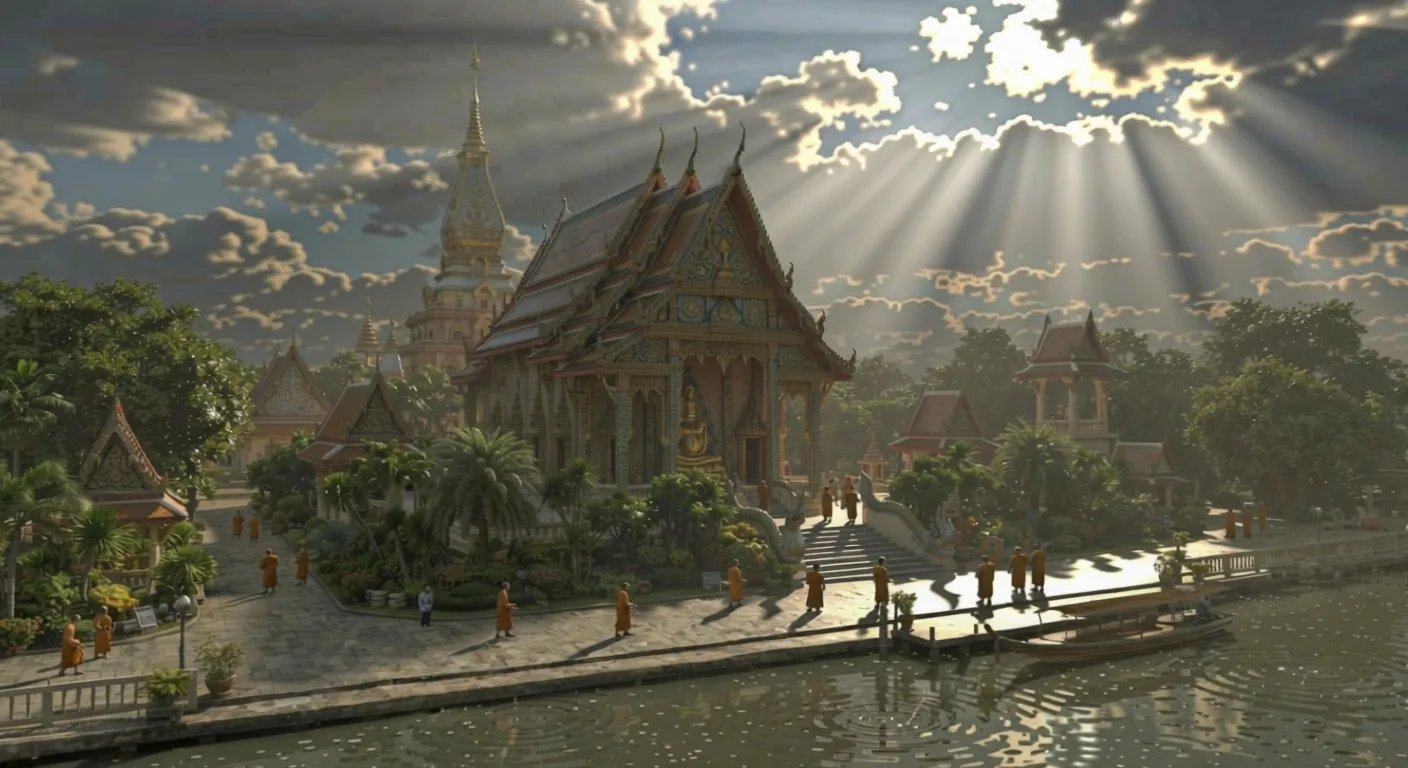
Wat Pak Khlong Makham Thao (วัดปากคลองมะขามเฒ่า), also widely known as Wat Luang Pu Suk, is one of the most revered Buddhist temples in Chai Nat Province, central Thailand. The temple is situated at the mouth of Khlong Makham Thao, where the waterway connects with the Chao Phraya River.
The temple is particularly famous for its association with Phra Khru Wimon Khunakon, Luang Pu Suk Kesaro (หลวงปู่ศุข เกสโร), one of Thailand's most respected traditional Buddhist masters and a renowned figure in the history of Thai sacred objects.
Luang Pu Suk served as abbot of Wat Pak Khlong Makham Thao and developed the temple into an important centre of Buddhist practice and community life. His reputation for meditation, Buddhist learning and traditional sacred knowledge attracted devotees from many parts of Thailand.
Today, Wat Pak Khlong Makham Thao remains a significant pilgrimage destination. Visitors come to pay respects to Luang Pu Suk, explore the temple's historic buildings and murals, and learn about the long-standing Buddhist and cultural heritage of the Chai Nat region.
The Location and Name of Wat Pak Khlong Makham Thao
Wat Pak Khlong Makham Thao is located in Makham Thao Subdistrict, Wat Sing District, Chai Nat Province.
The temple stands beside the waterway known as Khlong Makham Thao, near its meeting point with the Chao Phraya River. The riverside environment has long been an important feature of the temple's identity.
According to Thailand's Office of National Buddhism, the temple's name is connected with an old tamarind tree that once stood near the Chao Phraya River in front of the temple. The name “Pak Khlong Makham Thao” may therefore be understood as referring to the mouth of the Makham Thao canal and the old tamarind tree associated with the area. ([cnt.onab.go.th](https://cnt.onab.go.th/th/content/page/index/id/648))
The peaceful riverside setting contributes greatly to the atmosphere of the temple and reflects the important relationship between waterways, communities and Buddhist monasteries in central Thailand.
The History of Wat Pak Khlong Makham Thao
Wat Pak Khlong Makham Thao is an old Buddhist temple with a long history in the Chai Nat area. Its modern identity became particularly closely connected with Luang Pu Suk, who served as its abbot and helped develop the temple into a respected centre of Buddhist practice.
During Luang Pu Suk's time, the temple attracted large numbers of disciples and lay devotees. People travelled to meet the monk, listen to Buddhist teachings, make merit and seek his guidance.
The temple consequently became known not only as a place of religious practice but also as an important community centre.
Thailand's Office of National Buddhism identifies the temple as a significant site associated with Luang Pu Suk and notes that his reputation continues to attract devotees despite his passing in B.E. 2466 (1923). ([cnt.onab.go.th](https://cnt.onab.go.th/th/content/page/index/id/648))
Luang Pu Suk Kesaro
Luang Pu Suk Kesaro was born with the name Suk Keswet in approximately B.E. 2390 (1847) in the Makham Thao area of what is now Chai Nat Province.
Because he was born and raised in the local community, Luang Pu Suk maintained a particularly strong connection with the people of the region.
He eventually entered the Buddhist monkhood and dedicated his life to Buddhist study, meditation and monastic practice.
Over time, his reputation spread far beyond Chai Nat. Devotees came to respect him for his disciplined monastic conduct, compassion, meditation practice and traditional knowledge.
He became known by the honorific Luang Pu Suk, a name that remains deeply respected among Thai Buddhists and collectors of Thai sacred objects.
Luang Pu Suk as Abbot of Wat Pak Khlong Makham Thao
Luang Pu Suk's period as abbot represents one of the most important chapters in the history of Wat Pak Khlong Makham Thao.
Under his leadership, the temple developed both physically and spiritually. His reputation attracted many disciples, and the temple became a destination for people seeking Buddhist teachings and guidance.
The temple's development was not limited to religious activities. Luang Pu Suk was also remembered for his contribution to the local community and for helping strengthen the temple as a centre of Buddhist life.
The relationship between Luang Pu Suk and Wat Pak Khlong Makham Thao became so strong that the temple is now commonly referred to as Wat Luang Pu Suk.
Luang Pu Suk and Prince Abhakara Kiartivongse
One of the most notable historical associations of Wat Pak Khlong Makham Thao is its connection with Prince Abhakara Kiartivongse, Prince of Chumphon, a son of King Chulalongkorn, Rama V.
Luang Pu Suk was regarded as one of the prince's respected Buddhist teachers.
Prince Abhakara, who is especially revered in Thailand for his contributions to the development of the Royal Thai Navy, maintained a close relationship with Luang Pu Suk.
This association adds an important historical dimension to Wat Pak Khlong Makham Thao because it connects the temple with both traditional Buddhist practice and an important figure in modern Thai history.
Prince Abhakara and the Temple's Artistic Heritage
According to Thailand's Office of National Buddhism, the temple's historic ubosot contains valuable mural paintings, including works attributed to Prince Abhakara Kiartivongse and members of his entourage.
The paintings are particularly noteworthy because some are written or labelled using Khom script, reflecting the historical use of traditional Indic-derived scripts in Thai Buddhist religious culture.
One section of the murals reportedly records the year B.E. 2433 (1890), providing an important historical reference for the artwork. ([cnt.onab.go.th](https://cnt.onab.go.th/th/content/page/index/id/648))
These murals make the temple particularly valuable to visitors interested in Thai Buddhist art, history and the cultural relationship between the monarchy, Buddhist institutions and traditional artistic practices.
The Historic Ubosot
The ubosot, or ordination hall, is one of the most important historic buildings at Wat Pak Khlong Makham Thao.
In Thai Buddhism, the ubosot is a particularly sacred structure because it is traditionally used for important monastic ceremonies, including ordinations and formal Sangha activities.
At Wat Pak Khlong Makham Thao, the ubosot is especially significant because of its historic mural paintings and connection with Luang Pu Suk and Prince Abhakara.
The building therefore represents both an active religious space and an important piece of Thai cultural heritage.
The Murals of Wat Pak Khlong Makham Thao
The murals inside the temple are among the most valuable artistic features of Wat Pak Khlong Makham Thao.
Traditional Buddhist murals commonly communicate religious narratives, moral principles and Buddhist cosmology through visual storytelling. At Wat Pak Khlong Makham Thao, the paintings also provide a connection to the artistic environment of the late nineteenth and early twentieth centuries.
The association with Prince Abhakara makes the murals particularly unusual and historically interesting.
The use of Khom script within the artwork further demonstrates the continuing influence of traditional Buddhist literary and artistic culture in Thailand during this period.
The Luang Pu Suk Mondop
Another important feature of Wat Pak Khlong Makham Thao is the mondop associated with Luang Pu Suk.
According to local records, Luang Pu Suk began constructing the mondop in B.E. 2456 (1913). However, he passed away before the structure could be completed.
The building was subsequently restored and preserved as part of the temple's historical heritage.
The mondop serves as an important reminder of Luang Pu Suk's role in developing the temple and remains one of the places where visitors can reflect upon his legacy. ([cnt.onab.go.th](https://cnt.onab.go.th/th/content/page/index/id/648))
The Old Kuti of Luang Pu Suk
The temple also preserves the old kuti associated with Luang Pu Suk.
A kuti is the traditional residence of a Buddhist monk. Preserving the kuti of a highly respected monk provides visitors with an opportunity to understand the physical environment in which he lived and practised.
The simple nature of a traditional monastic residence also reflects the Buddhist values of restraint and simplicity.
For devotees, the old kuti represents a direct connection with Luang Pu Suk's life at Wat Pak Khlong Makham Thao.
Images and Memorials of Luang Pu Suk
Visitors to Wat Pak Khlong Makham Thao can pay respects to images and memorial representations of Luang Pu Suk Kesaro.
The temple preserves photographs dating from the period when Luang Pu Suk was still alive, together with a wax representation and other objects associated with his life.
These materials are valuable because they provide visitors with a more personal connection to the monk and help preserve the memory of his appearance, lifestyle and historical role.
For devotees, such images are also objects of reverence and remembrance.
Luang Pu Suk and Thai Buddhist Sacred Objects
Wat Pak Khlong Makham Thao occupies an important position in the history of Thai Buddhist amulets and sacred objects.
Luang Pu Suk is regarded as one of the most famous traditional masters associated with sacred objects in Thailand. Objects bearing his name and associated with Wat Pak Khlong Makham Thao are highly sought after by collectors and devotees.
The Office of National Buddhism specifically identifies the temple as being well known for its พระเครื่อง, or Thai Buddhist amulets, and notes the continuing popularity of Luang Pu Suk sacred objects. ([cnt.onab.go.th](https://cnt.onab.go.th/th/content/page/index/id/648))
His name is associated with several categories of sacred objects, including medallions, Buddha images, cast and moulded amulets, talismans and other traditional devotional objects.
Because Luang Pu Suk is such a famous figure in Thai amulet collecting, objects attributed to him should be studied carefully according to their exact type, material, mould, inscription, year and provenance.
Luang Pu Suk Amulets and Collecting
Luang Pu Suk amulets from Wat Pak Khlong Makham Thao occupy an important position in Thai amulet collecting.
Collectors often study differences between editions, materials, moulds, inscriptions and manufacturing characteristics. The historical context of each object is particularly important because the reputation of Luang Pu Suk has resulted in many later devotional objects being produced in his name.
A responsible collector should therefore avoid identifying an amulet solely from a photograph or from a general resemblance to a recognised type.
Important factors include the temple, monk, production period, material, dimensions, mould characteristics, surface condition, inscriptions and provenance.
Where authenticity is important, comparison with established reference examples and consultation with qualified specialists is recommended.
Traditional Beliefs Associated with Luang Pu Suk Amulets
Thai devotees have traditionally associated Luang Pu Suk's sacred objects with qualities such as protection, safety, good fortune, loving kindness and spiritual support.
The Office of National Buddhism records local beliefs that devotion to Luang Pu Suk may be associated with auspiciousness, safety from danger and the fulfilment of wishes. Traditional beliefs concerning his sacred objects also include luck, popularity and protection. ([cnt.onab.go.th](https://cnt.onab.go.th/th/content/page/index/id/648))
These beliefs should be understood within the context of Thai Buddhist devotional culture rather than presented as scientifically proven supernatural effects.
For collectors and historians, the cultural and historical significance of Luang Pu Suk amulets can be appreciated independently of supernatural claims.
Luang Pu Suk's Spiritual Legacy
Luang Pu Suk's enduring reputation rests on more than the sacred objects associated with his name.
He is remembered as a respected Buddhist monk who dedicated his life to monastic discipline, meditation, Buddhist practice and the development of his temple.
His relationship with Prince Abhakara further contributed to the historical importance of his legacy.
For many devotees, Luang Pu Suk represents the ideal of a traditional Thai master whose spiritual reputation was developed through practice, discipline and service to the Buddhist community.
Wat Pak Khlong Makham Thao and the Chai Nat Community
Wat Pak Khlong Makham Thao has long been closely connected with the local community.
As with many historic Thai temples, it has served not only as a place of worship but also as a centre for merit-making, religious ceremonies and community activities.
The temple's riverside location reflects the traditional importance of waterways to communities in central Thailand. Rivers and canals historically served as transportation routes and helped connect villages, markets and temples.
Wat Pak Khlong Makham Thao therefore represents an important combination of religious, environmental and community heritage.
Wat Pak Khlong Makham Thao as a Place of Pilgrimage
Devotees from Chai Nat and other parts of Thailand continue to visit Wat Pak Khlong Makham Thao to pay respects to Luang Pu Suk and other sacred figures associated with the temple.
Visitors can explore the historic ubosot, view the murals, pay respects to Luang Pu Suk and Prince Abhakara, and visit the preserved monastic areas connected with the temple's history.
The temple is particularly meaningful to people interested in Luang Pu Suk's life and the history of Thai sacred objects.
For those who approach the temple as a place of Buddhist practice, the visit can also be an opportunity for quiet reflection, merit-making and contemplation.
Visiting Wat Pak Khlong Makham Thao
Wat Pak Khlong Makham Thao is located in Makham Thao Subdistrict, Wat Sing District, Chai Nat Province.
The temple is situated beside the Chao Phraya River near the mouth of Khlong Makham Thao, providing a peaceful riverside environment.
Visitors should dress appropriately when entering the temple and sacred buildings. Modest clothing, quiet behaviour and respect for Buddhist customs are recommended.
Photography should be carried out carefully, particularly inside the ubosot and around historic murals, sacred objects and areas used for worship.
Visitors should also follow current instructions from temple authorities regarding access to historic buildings and religious areas.
Wat Pak Khlong Makham Thao and Thai Buddhist Heritage
Wat Pak Khlong Makham Thao is significant because it brings together several important elements of Thai heritage.
These include Buddhist religious practice, traditional monastic culture, historic murals, riverside architecture, royal connections and Thai sacred-object traditions.
The temple's association with Luang Pu Suk makes it particularly important in the history of Thai Buddhist masters. Its connection with Prince Abhakara provides an additional link to the history of the Thai monarchy and the development of the Royal Thai Navy.
The temple's sacred objects and murals also demonstrate how Buddhist faith, traditional craftsmanship and Thai cultural identity have remained closely connected over generations.
Why Wat Pak Khlong Makham Thao Matters
Wat Pak Khlong Makham Thao is more than a famous temple associated with a revered monk. It is a living historical site where several important strands of Thai culture intersect.
The temple preserves the memory of Luang Pu Suk Kesaro, whose reputation continues to influence Thai Buddhist devotion and amulet collecting.
It also preserves historic buildings, murals and objects associated with the period in which Luang Pu Suk lived. The connection with Prince Abhakara Kiartivongse adds another important dimension to the temple's history.
For students of Thai Buddhism, the temple provides an opportunity to study the relationship between monastic practice, sacred objects and popular devotion.
For art and history enthusiasts, its murals and preserved structures offer valuable insight into the cultural environment of central Thailand during the late nineteenth and early twentieth centuries.
Conclusion
Wat Pak Khlong Makham Thao is one of Chai Nat's most important Buddhist temples and one of the principal places associated with Luang Pu Suk Kesaro.
Situated beside the Chao Phraya River at the mouth of Khlong Makham Thao, the temple combines a peaceful riverside setting with a rich history of Buddhist practice and cultural heritage.
Luang Pu Suk's role as abbot transformed the temple into an important centre of Buddhist devotion, while his association with Prince Abhakara Kiartivongse further strengthened its historical significance.
The temple's historic ubosot, valuable murals, Luang Pu Suk's old kuti, his memorial images and the mondop begun in B.E. 2456 (1913) provide visitors with numerous connections to the monk's life and legacy. ([cnt.onab.go.th](https://cnt.onab.go.th/th/content/page/index/id/648))
For Thai amulet enthusiasts, Wat Pak Khlong Makham Thao holds a special place because of the enduring reputation of Luang Pu Suk sacred objects. For devotees, it remains a place of reverence, merit-making and spiritual remembrance.
Above all, Wat Pak Khlong Makham Thao stands as a lasting symbol of Buddhist faith, traditional Thai craftsmanship, monastic discipline, local community heritage and the enduring legacy of Luang Pu Suk Kesaro.