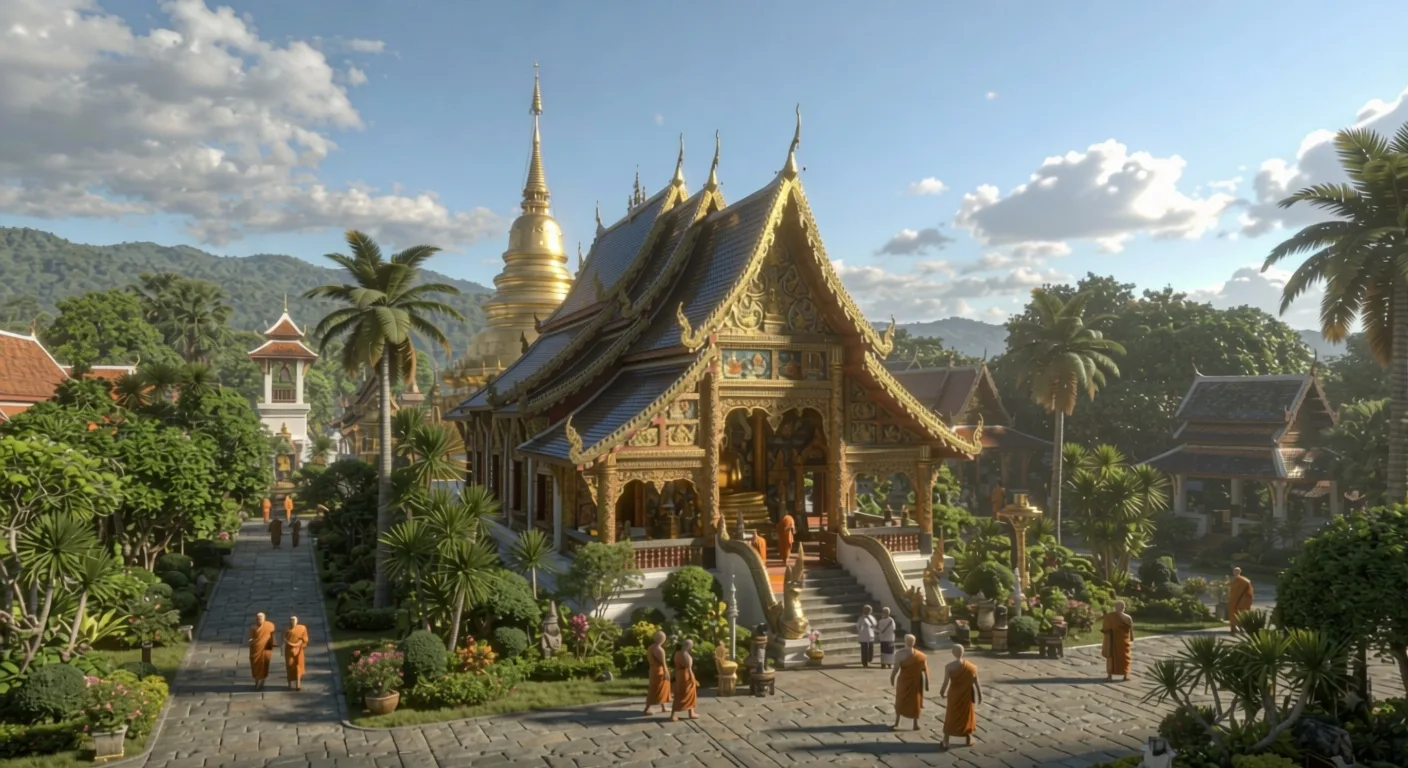
Wat Doi Mae Pang: A Temple of Luang Pu Waen Sujinno
Wat Doi Mae Pang (วัดดอยแม่ปั๋ง) is a respected Buddhist temple located in Mae Pang Subdistrict, Phrao District, Chiang Mai Province, northern Thailand. The temple is especially renowned for its close association with Luang Pu Waen Sujinno (หลวงปู่แหวน สุจิณโณ), one of the most revered monks of Thailand's modern forest meditation tradition.
Wat Doi Mae Pang became particularly important in the life of Luang Pu Waen after he moved there in B.E. 2505 (1962). He remained at the temple until his passing on 2 July B.E. 2528 (1985). The temple therefore represents an important physical and spiritual connection with the final decades of the monk's life.
Today, devotees and visitors can see several places connected with Luang Pu Waen, including the temple's wooden vihara, his kuti, the wooden building traditionally known as Rong Yang Kilesa or Rong Fai, a life-size image of the monk and a museum containing his image, relics and monastic belongings.
The History of Wat Doi Mae Pang
Wat Doi Mae Pang is situated in the mountainous environment of Phrao District, approximately 75 kilometres from central Chiang Mai by the Chiang Mai–Mae Jo–Phrao route. The temple is surrounded by the natural landscape of northern Thailand, providing a setting that is particularly appropriate for the contemplative character of the forest-monk tradition.
Available Thai temple records identify the temple as having been established in B.E. 2479 (1936). Its importance grew considerably after Luang Pu Waen came to reside there in 1962.
Over the decades that followed, Wat Doi Mae Pang became closely identified with the monk and his practice. The temple's buildings, meditation areas and memorial spaces preserve important aspects of the religious environment in which Luang Pu Waen spent the later part of his life.
Luang Pu Waen Sujinno
Luang Pu Waen Sujinno is regarded as one of Thailand's most respected forest monks of the twentieth century.
He was born on 16 January B.E. 2430 (1887) in Loei Province in northeastern Thailand. Accounts of his early life describe a family background connected with farming and traditional blacksmithing.
From an early age, Luang Pu Waen developed a strong interest in monastic life and Buddhist practice. His spiritual development eventually brought him into the lineage of the great forest meditation masters, including Phra Ajahn Sao Kantasilo and other teachers of the Thai forest tradition.
His life was characterised by long periods of meditation, austere practice, pilgrimage and forest wandering. Over time, his reputation as a practitioner of Buddhist meditation spread well beyond the regions where he lived.
Luang Pu Waen and the Thai Forest Tradition
Luang Pu Waen's spiritual identity is strongly connected with the Thai Forest Tradition, a Buddhist monastic movement that places particular emphasis on meditation, disciplined conduct, simplicity and direct contemplation of the teachings of the Buddha.
Forest monks traditionally seek secluded environments where they can devote themselves to meditation and spiritual practice. Wandering through forests and remote areas has historically been regarded as a means of reducing distractions and encouraging mindfulness.
Luang Pu Waen followed this style of practice for many decades. His reputation was therefore built primarily upon his monastic discipline and meditation practice rather than upon material possessions or worldly status.
For students of Thai Buddhism, his life provides an important example of the continuing influence of the forest meditation tradition in modern Thailand.
Luang Pu Waen at Wat Doi Mae Pang
The most important chapter in the modern history of Wat Doi Mae Pang began in B.E. 2505 (1962), when Luang Pu Waen came to reside at the temple.
He remained at Wat Doi Mae Pang for the rest of his life, making the temple the principal location associated with his later years. The Department of Community-Based Tourism specifically identifies the period from 1962 until his death in 1985 as the defining association between Luang Pu Waen and Wat Doi Mae Pang.
During these years, increasing numbers of devotees travelled to the temple to meet the revered monk, seek Buddhist teachings and pay their respects.
The temple consequently became an important pilgrimage destination and remains closely associated with Luang Pu Waen's spiritual legacy.
The Wooden Vihara
One of the notable structures at Wat Doi Mae Pang is its wooden vihara.
The vihara forms part of the temple's traditional religious environment and reflects the simple architectural character associated with a forest monastery.
For visitors interested in Luang Pu Waen's history, the wooden structures at Wat Doi Mae Pang are particularly meaningful because they preserve the physical setting in which the monk lived and practised.
Rather than being viewed only as architectural attractions, these buildings can be understood as part of the historical environment of a respected forest monk.
Luang Pu Waen's Kuti
Another important site is the kuti of Luang Pu Waen.
A kuti is a traditional monastic residence used by monks for living, study, meditation and rest. The preservation of Luang Pu Waen's kuti provides visitors with a direct connection to the everyday environment of his later monastic life.
The modest character of the building reflects an important principle of the forest tradition: simplicity and reduction of unnecessary material distractions.
For devotees, visiting the kuti is an opportunity to remember Luang Pu Waen and reflect upon his dedication to Buddhist practice.
Rong Yang Kilesa – The “Fire House”
Among the most distinctive places associated with Luang Pu Waen at Wat Doi Mae Pang is a small wooden building traditionally known as Rong Yang Kilesa, or Rong Fai.
The expression can be translated approximately as the place for “burning the defilements,” reflecting Buddhist terminology concerning the overcoming of mental impurities such as greed, hatred and delusion.
The name provides a particularly meaningful connection with the contemplative ideals of the forest tradition. Rather than referring simply to physical fire, the expression can be understood symbolically as referring to the practice of overcoming the mental conditions that obstruct liberation.
The building has therefore become an important part of the historical and spiritual landscape associated with Luang Pu Waen.
The Life-Size Image of Luang Pu Waen
Wat Doi Mae Pang also houses a life-size image of Luang Pu Waen Sujinno.
Devotees visit the image to pay respects and remember the monk's life and teachings. Such images are common devotional features at Thai Buddhist temples associated with highly respected monks.
For many visitors, the image provides a focal point for reflection and remembrance, particularly for those who cannot meet the monk in person.
The Luang Pu Waen Museum and Relics
Another important feature of Wat Doi Mae Pang is the museum or mondop dedicated to Luang Pu Waen.
The collection includes a likeness of the monk as well as his relics and monastic belongings. These objects provide an important historical record of his life and offer visitors a deeper understanding of the austere environment in which he lived.
Monastic belongings can be particularly valuable to historians because they provide physical evidence of everyday Buddhist practice. Robes, personal utensils, religious objects and other possessions can help illustrate the disciplined lifestyle traditionally followed by forest monks.
For devotees, the preservation of these objects also provides a tangible connection with a monk whose teachings and reputation continue to influence Thai Buddhist communities.
Luang Pu Waen's Buddhist Practice
Luang Pu Waen was widely respected for his commitment to meditation and disciplined monastic practice.
The forest tradition emphasises direct observation of the mind, mindfulness, concentration and insight into the nature of existence. These practices are intended to reduce attachment and cultivate wisdom and compassion.
Luang Pu Waen's reputation developed within this framework. His simple lifestyle, quiet character and dedication to meditation became important aspects of the way devotees understood his spiritual life.
For those visiting Wat Doi Mae Pang, the temple can therefore be viewed not simply as a memorial to a famous monk but as a place where the principles of forest meditation remain closely connected to the physical environment.
Wat Doi Mae Pang and Thai Buddhist Amulet Culture
Wat Doi Mae Pang also has an important connection with the history of Thai Buddhist amulets and sacred objects associated with Luang Pu Waen.
Amulets bearing Luang Pu Waen's name and image became widely recognised among Thai devotees and collectors. They may include medallions, Buddha images, portrait amulets and other sacred objects produced during different periods.
For devotees, such objects can serve as reminders of Luang Pu Waen's teachings, Buddhist faith and spiritual legacy.
For collectors, Luang Pu Waen amulets represent an important chapter in twentieth-century Thai amulet history. Different editions can vary according to year, material, mould, design, inscriptions and production method.
Collecting Luang Pu Waen Amulets
Collectors studying Luang Pu Waen amulets should identify the exact temple, monk, year and edition whenever possible.
Important factors may include the amulet type, production year, material, mould characteristics, inscriptions, dimensions, surface condition and provenance.
Because famous monk amulets are frequently reproduced, collectors should not determine authenticity from general appearance alone. Comparison with reliable reference examples and consultation with experienced specialists can provide a more responsible approach to identification.
The cultural significance of an amulet should also be distinguished from its monetary value. For devotees, an amulet may have profound personal and religious meaning regardless of its market price.
Traditional Beliefs Associated with Luang Pu Waen Amulets
Devotional traditions surrounding Luang Pu Waen amulets may associate them with qualities such as protection, compassion, peace of mind and spiritual encouragement.
Such interpretations form part of Thai Buddhist and local devotional culture. They should be understood as matters of religious belief and tradition rather than scientifically established supernatural effects.
The historical importance of these objects can nevertheless be studied independently through their connection with Luang Pu Waen, Wat Doi Mae Pang, Thai Buddhist art and the development of twentieth-century amulet culture.
Wat Doi Mae Pang as a Place of Pilgrimage
Wat Doi Mae Pang continues to attract Buddhist devotees and visitors interested in Luang Pu Waen's life and legacy.
Visitors can pay respects at the temple's Buddha images, Luang Pu Waen's memorials and preserved monastic sites. The museum and historical buildings also provide opportunities to learn about his life and practice.
The temple's peaceful setting in the northern Thai countryside complements its association with the forest tradition and provides an atmosphere suitable for quiet reflection.
For devotees, the journey to Wat Doi Mae Pang can therefore be both a pilgrimage and an opportunity to remember the values of Buddhist practice.
The Cultural Heritage of Phrao and Chiang Mai
Wat Doi Mae Pang is located in Mae Pang Subdistrict, Phrao District, Chiang Mai Province, an area surrounded by the mountainous landscape of northern Thailand.
The temple contributes to the cultural heritage of the Phrao area through its Buddhist traditions, architecture and connection with one of Thailand's best-known forest monks.
Its location away from central Chiang Mai also contributes to the contemplative character of the site. The surrounding landscape helps visitors understand why remote forests and mountain environments have historically been important to Thai forest monks.
Visiting Wat Doi Mae Pang
Visitors should remember that Wat Doi Mae Pang remains an active Buddhist temple and should behave respectfully.
Modest clothing is recommended when visiting the temple and sacred buildings. Visitors should remove footwear where required, speak quietly in religious areas and follow instructions from monks or temple authorities.
Photography should be undertaken respectfully, especially around Buddha images, relics, monastic belongings and areas used for worship or meditation.
Visitors interested specifically in the museum, relics or preserved buildings should check current access arrangements before travelling, as individual areas may have different opening arrangements.
Why Wat Doi Mae Pang Matters to Thai Buddhist Heritage
Wat Doi Mae Pang is significant because its identity is closely connected with one of Thailand's most respected forest monks.
The temple preserves not only the memory of Luang Pu Waen Sujinno but also physical locations connected with his later years: his kuti, wooden religious buildings, memorial image and preserved belongings.
For students of Thai Buddhism, the temple provides insight into the Thai Forest Tradition and the importance of meditation and disciplined monastic practice.
For devotees, it remains a place of remembrance and spiritual reflection. For Thai amulet collectors, it represents an important source of sacred objects associated with one of the country's most respected twentieth-century monks.
Conclusion
Wat Doi Mae Pang is one of northern Thailand's important Buddhist temples and one of the places most closely associated with Luang Pu Waen Sujinno.
His arrival at the temple in B.E. 2505 (1962) marked the beginning of a period that would permanently connect Wat Doi Mae Pang with his name and spiritual legacy. He remained there until his passing in B.E. 2528 (1985).
The preserved kuti, wooden vihara, Rong Yang Kilesa, life-size image, museum, relics and monastic belongings allow visitors to encounter the physical environment associated with his later years.
For devotees, Wat Doi Mae Pang is a place of faith, remembrance and meditation. For students of Thai Buddhist history, it provides an important connection with the Thai Forest Tradition. For collectors, it represents an important chapter in the history of Luang Pu Waen amulets and sacred objects.
Above all, Wat Doi Mae Pang stands as a lasting reminder of the values of simplicity, meditation, discipline, compassion and Buddhist practice that defined the life and legacy of Luang Pu Waen Sujinno.