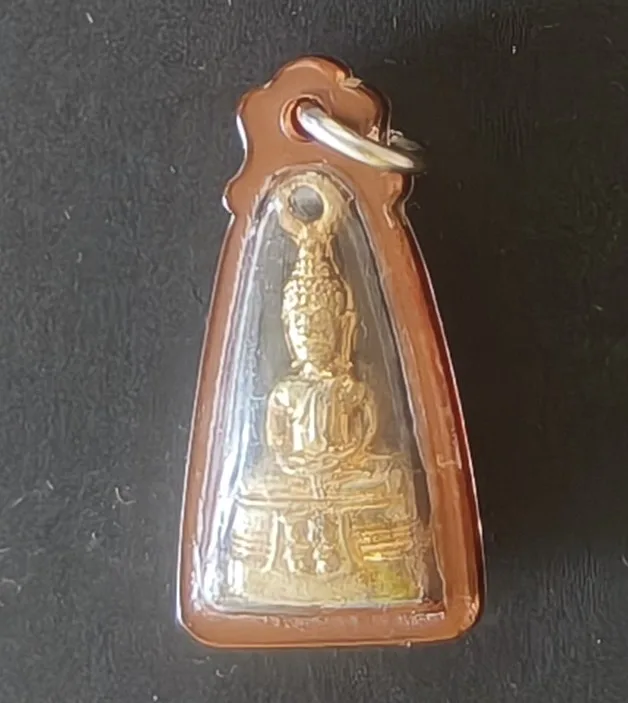
 Hover to view full image
TA-008 · available
Phra Yod Thong
Phra Yod Thong is a traditional form of Thai Buddhist sacred imagery and amulet that has been produced in various styles and editions throughout Thailand. The name is associated with distinctive Buddha imagery and traditional Thai sacred-art forms, with individual productions differing according to their temple, period, master, material and design.
Unlike amulets that can be traced to one clearly documented production, Phra Yod Thong may refer to different productions and artistic traditions. As a result, the temple, monk, province, year and material should be identified according to the particular specimen being catalogued.
Phra Yod Thong examples may portray the Buddha in a seated or other traditional Buddhist posture, with the overall design reflecting the artistic style of the period and temple in which it was produced. Variations in the Buddha's facial features, body proportions, base, surrounding elements, inscriptions and construction can be important when distinguishing different editions.
Depending on the production, Phra Yod Thong may be made from sacred metal alloys such as bronze, brass or copper, as well as sacred powder, clay, or other consecrated materials. Some productions may incorporate sacred powders, herbs, minerals, or other materials prepared according to the religious traditions of the temple or master.
In Thai Buddhist devotional culture, Phra Yod Thong is traditionally regarded as an auspicious sacred object associated with protection, spiritual strength, stability, good fortune and Buddhist blessings. These traditional associations are rooted in faith and cultural practice and should not be presented as scientifically proven supernatural effects.
The Buddhist significance of the amulet ultimately relates to devotion and remembrance of the Buddha and his teachings. For devotees, carrying or respectfully keeping a Buddhist amulet can serve as a personal reminder of faith, morality, mindfulness and spiritual cultivation.
From a collecting perspective, Phra Yod Thong should be studied according to its specific origin rather than treated as a single standardized amulet. Collectors may examine the Buddha's posture and proportions, mold characteristics, base design, inscriptions, material, dimensions, surface and aging characteristics, production techniques, provenance and condition.
Because different temples and periods may have produced similar-looking Buddha images, visual appearance alone should not be used to determine the exact origin of an amulet. Historical documentation, established collector references and provenance can provide important supporting evidence.
When cataloguing a particular Phra Yod Thong, it is preferable to record the exact temple, monk or master, province, production year, edition, material and provenance whenever these details are reliably established.
Later commemorative productions and modern temple issues should also be distinguished from older historical examples. The same general name may be used across different generations, and therefore an accurate database should preserve the specific edition information whenever available.
Today, Phra Yod Thong remains an interesting part of Thai Buddhist amulet culture. Its traditional Buddha imagery, spiritual associations and variety of temple productions make it meaningful to devotees while also offering collectors an opportunity to study the development of Thai Buddhist sacred art across different periods and regions.
IMPORTANT PAYMENT NOTICE
By proceeding with payment, you acknowledge that your payment is final and non-refundable, except where a refund is expressly approved by us or required by applicable law.
Please review your offer, the Item details, rental conditions, applicable fees, and Terms & Conditions carefully before making payment.
By completing payment, you confirm that you have read and accepted our Terms & Conditions.
- Temple
- Various Thai temples
- Monk
- Various monks and masters
- Material
- Sacred metal alloys, bronze, brass, copper, sacred powder, clay, and other consecrated materials depending on the edition